Ken LaCosse Interview
By Joe Browning
BACKGROUND
Please explain a little about your background with both shakuhachi making and playing. How did you get started with both? Who did you study with?
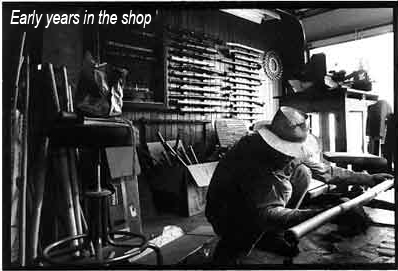
In 1987, I was looking though a book about bamboo uses called Bamboo (Austin, Levy, Ueda). There was a piece about shakuhachi maker Kozo Kitahara which fascinated me. I was immediately drawn to the mystique of shakuhachi making. The exotic beauty of the bamboo, the deceptive simplicity of the instrument and the solitary nature of the work seduced me. I harvested local, creek side bamboo and made attempts at flutes using the photographs in the book. I had never heard a shakuhachi played so I was learning how to make sounds as I worked on the flutes.
Gradually, I gathered recordings and more information about shakuhachi making and continued to work feverishly. Many hundreds of shakuhachi were turned out over the next few years. It was a passionate time of discovery.
By this time I was buying most of my bamboo from nurseries and bamboo importers. My connection to the bamboo was giddy-like. I remember once buying very long bamboo poles from a warehouse in downtown San Francisco. Without a plan to transport them I strapped them to my shoulder and happily walked the five mile journey home.
Eventually, my shakuhachi had reached a plateau of development. I was approaching this as a maker first and a player second. So, I decided to take formal shakuhachi playing lessons in hopes it would propel my flutes to the next level. I studied with Masayuki Koga and his student Tim Hamano in San Francisco. That experience proved to be the first major turning point in my development as a maker.
Looking back, it seems odd that I never considered studying shakuhachi making formally. At the time, it never occurred to me. Making has always been my first love. I had the passion to work and experiment so it seemed very natural to learn by working privately.
Can you say something about your work prior to Taimu – what kinds of shakuhachi were you making?
I was making conventional size shakuhachi in the range of approximately 1.3 to 2.4. The bamboo ranged from non-root, Chinese root-end to aged Japanese madake.
These were heavily influenced by the jinashi, Edo-period shakuhachi of John Singer. John was kind enough to allow me to study his flutes. I was particularly drawn to the rich, depth of tone found in many of these flutes. Drawing on this sound and working with a sense of osmosis, I felt I was beginning to develop a particular voice as a shakuhachi maker.
I was also making a more modern, cast-bore style of shakuhachi. This was a style intended more for students who were studying formally.
Presently, I focus on both conventional size jinashi and the larger and wider Taimu.
DEVELOPMENT OF TAIMU
Can you give approximate dates (years) for the development of Taimu, from initial ideas to the invention of “Taimu” as a distinctive type of shakuhachi?
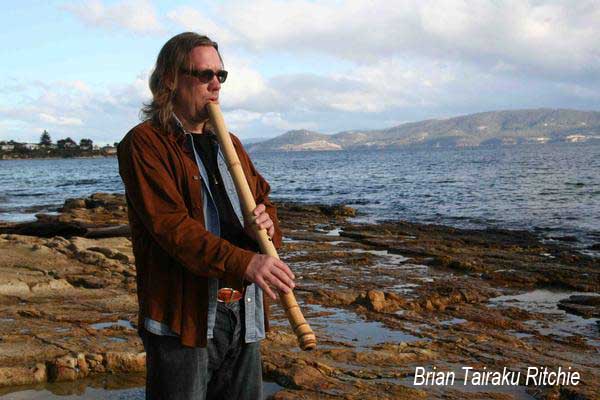
In the late 90’s, shakuhachi player Brian Tairaku Ritchie contacted me searching for long and low pitched shakuhachi. That was the beginning of the Taimu adventure. We had a meeting of minds about the low shakuhachi sounds and shared a fun, experimental approach in finding them. Soon Brian began visiting when he was in town. He was collecting many shakuhachi at the time and would bring over his latest finds. Our experiments were often spontaneous and unscripted though centered on low pitched shakuhachi. Usually we would begin by deciding what particular kind of flute we wanted to create that day. Then, Brian would go in the backyard to play shakuhachi. I would work on the flute until I thought I had something. We would play it and talk over the results. Then, perhaps martinis in the evening. It was becoming a fertile creative partnership.

These visits and experiments continued over the next few years. It was the groundwork for which would eventually become Taimu. Early on we were interested in making the longest shakuhachi that were physically possible to play. This evolved into a few early prototypes until approximately 2002 when the first Taimu-like shakuhachi appeared.
Can you describe the events that made you switch from experimenting with long flutes to wide-bore flutes?
Initially, we focused on low pitch through flute length, using conventional bore width ratios for these lengths. In other words, we made larger replicas of conventional size shakuhachi. For us, this seemed like a logical approach. These shakuhachi were certainly low pitched and successful in their own way, but there was a trade off. The tone was relatively clean and focused. We wanted a big, complex sound that could be pushed and manipulated.
On cue, Brian brought over a long and unusually wide (at that time) shakuhachi made by Gudo Ishibashi. This flute played with complexity and power. Its tone was clearly in the direction we wanted to go. Until that time we had concentrated on flute length rather than width. It was immediately obvious that a wider bore could be experimented with to find what we where looking for. And so we did.
Was there a distinct “first” Taimu or several prototypes leading up to it? Can you remember your first impressions of this first flute and its sound?
There was a lot of experimentation and failure leading up to the Taimu design. The first being the long, conventional width flutes. Some of these were acceptable in their own way. However, we were looking for a less focused tone so we continued to experiment.
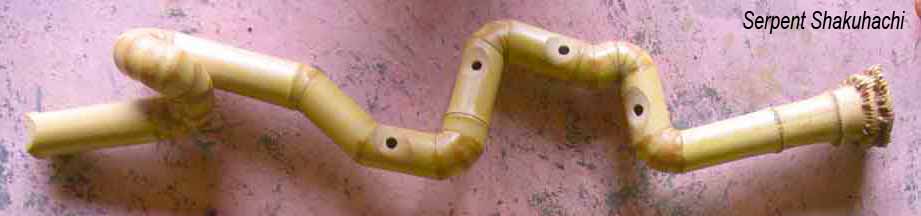
Next came the Serpent Shakuhachi. These were made from extra long culms cut and glued together to form bends. The idea here was to make it comfortable to play a flute that would be impossibly long to play without the bends. These were made before our concentration shifted to width. For our purposes, many of these were too thin. I do think there are good possibilities ahead for wider Serpent Shakuhachi.
There were also wide bore attempts which failed because of bore issues or hole size problems. We later discovered large, undercut holes were an absolute must for the big, complex Taimu sound.
The first group that would be considered “Taimu” was inspired by the wide bore Ishibashi shakuhachi. Some of these flutes played with glowing tones which I had never encountered in large flutes. I focused on this characteristic in the first Taimu.
These first Taimu were exciting for us. They were a major jump in improvement from the earlier experiments. I was beginning to understand the specific design characteristics necessary to find this glowing, powerful tone. From that point it has been a continuation in developing and expanding upon that glowing tone.
You mention several key inspirations for Taimu such as Edo-period flutes and the “foghorn” sound. Did these influences occur to you in sequence or as a group? How did the idea of “foghorn” sound occur to you?
The Edo-period flutes of John Singer were the main inspiration behind my conventional size, jinashi shakuhachi. The “Foghorn Glow” is specific to Taimu and was first inspired by the shakuhachi of Ishibashi.
The most successful of the early Taimu played with a unique glow. They sounded and felt like the foghorns I often hear on the coast of San Francisco. Brian and I felt “Foghorn Glow” would be an accurate term to describe the specific sound we were developing.
Similarly with the technical side, did you make the technical innovations gradually, or were there “eureka” moments when certain problems were solved or advances made?
There were both gradual advances and “aha” moments. The early experiments were fun and playful. They involved a lot of guesswork, imagination and glorious failures. They were approached with the idea that there was nothing to lose. As a result, advances were occurring but they were gradual.
The major breakthrough came with the discovery of the wide bore influence on tone. At that moment we realized we were onto something. From there it was a matter of fine tuning other technical matters to further support the big sound we were honing in on - hole size, bottom bore end size, utaguchi angle, top end opening, etc.
The development of Taimu includes both technical and aesthetic factors. Has the aesthetic always driven the technical, or has it also worked in the other direction?
For Taimu, I think the technical and aesthetic factors are the sides of one coin.
All flutes are bound by physical laws. There is no way around it. In terms of shakuhachi, there is a window of bore width to length possibilities. This ratio is referred to as “aspect ratio.” A thin AR results in a focused, pure tone. Going too far in this direction results in poor low octave tone and tuning. A wide AR results in a breathy, complex tone. Going too far in this direction results in poor upper octave tone and tuning. It is easiest to make a shakuhachi in the middle of these extremes. The challenge of Taimu shakuhachi is pushing the wide AR to its physical limit while maintaining excellent tone and octave tuning. It is a matter of riding the edge of one extreme.
Making a good Taimu is like a successful tight rope dance. An understanding of both technical and aesthetic factors is necessary. It is both science and art. I don’t know what drives what.
Some shakuhachi players talk about the importance of playing shakuhachi outside, and you describe how playing by the ocean informed your work on Taimu. Was this a significant influence?
Playing Taimu outside is significant in the sense that it provides an enhanced way of experiencing its unique tone. The big sound of Taimu vibrates throughout the players body. Playing next to the competition of a loud ocean makes one hear less and feel the vibration more. In that respect it provides a way for me to more fully test a flute and judge its success.
It can also force one to play with power. In that way it is good training to expand one’s range on any shakuhachi.

MATERIALS
I know you use primarily Japanese and Chinese madake (plus PVC). I’m very interested in any details you’re willing to provide about how you source your bamboo. What region of Japan does your bamboo come from? Do you harvest your own?
In the early 90’s, I purchased many hundreds of Japanese madake rootend pieces from the maker John Niemi in Osaka, Japan. I believe he inherited them from his shakuhachi making father in law. I have many of these pieces left and continue to use them for conventional size, jinashi shakuhachi. They are over thirty five years old now and are the best pieces I’ve been able to obtain for flutes of these sizes.
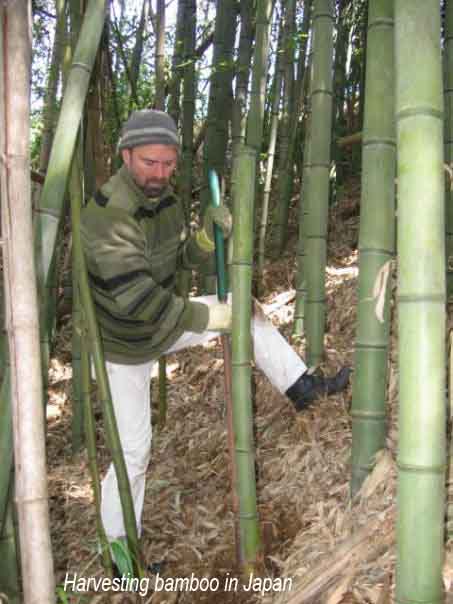
For Taimu, the best pieces I’ve been able to harvest or purchase consistently come from the mountains of Nagano Prefecture in Japan.
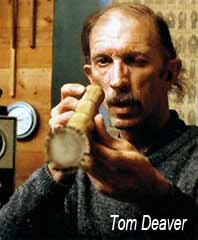
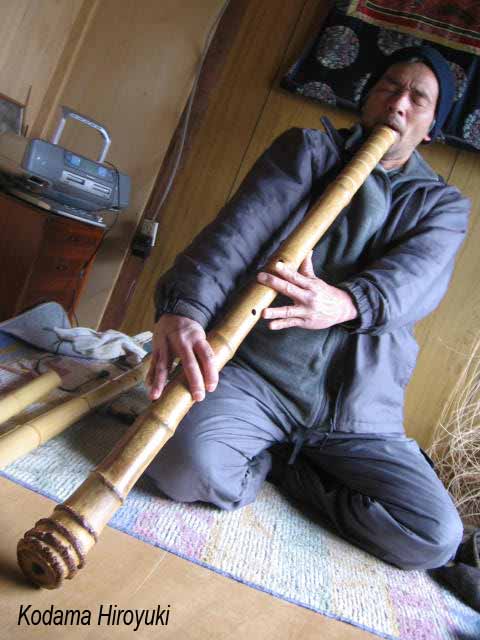
The late shakuhachi maker Tom Deaver was very helpful in opening the door for me to harvest wide bamboo in that area. I stayed with Tom a few times on harvesting trips to Japan. He took me to his favorite groves in the morning. We’d harvest then drive back up the hill to his quiet home. In the afternoon we’d trim the roots and tend to his blueberry field. In the evening we would light the stove and watch sumo and baseball on television. His neighbor, maker and player Kodama Hiroyuki has also been a kind and generous ally in harvesting as well as purchasing bamboo for Taimu.
On occasion, I have also purchased fine quality Taimu bamboo from Shanghai, China.
For more basic, conventional size shakuhachi, I also use Chinese root bamboo imported by Frank’s Cane and Rush Supply in California. These pieces are more arbitrarily harvested so quality varies. However, there are often some gems in a batch.
I’ve also harvested bamboo in Hawaii and experimented with local groves. So far, success with these pieces have not been consistent enough to pursue. I do think good pieces are out there somewhere though.
Is it any more or less easy to obtain quality madake with dimensions suitable for Taimu, compared to standard shakuhachi?
It is more labor intensive to harvest wide bamboo. But in terms of availability, I haven’t noticed a difference. In my experience in Nagano, we simply searched in groves with wider culms. Those looking for conventional size bamboo searched in groves with thinner culms.
I might add here that only a very small percentage of bamboo in an ideal grove will be suitable for shakuhachi. So, I think both sizes are equally difficult to obtain.
In your time making shakuhachi, have you noticed any significant changes in the availability or quality of bamboo, or particular sizes of bamboo stock?
I haven’t noticed any significant change. There is discussion in the shakuhachi community about whether older bamboo is better or different than bamboo presently in the groves. Bamboo groves are living and changing. However, my hunch is that the bamboo is out there. It’s just a matter of locating it through a keen eye.
METHODS AND PROCESS
You’ve written online about the range of experiences possible with shakuhachi. I’m interested how this works in the balance between calculation and intuition when making flutes. As you know, some makers talk about searching for the individual sound of each particular piece of bamboo, or say that some of their best instruments are “happy accidents”. Similar ideas comes across in your writing.
-- Has this been part of your flute-making approach from the beginning? How did this idea – of finding the unique voice of each piece of bamboo – first occur to you? Through conversation with other makers, something you read, or in the experience of making?
One of the interesting things about shakuhachi making is that a maker can approach it in different ways. One way is to look at it in much the same way as waking up and experiencing each new day; different weather conditions, different challenges, making due with what is given. Or, a decision can be made to exert more control from the beginning in order reach a predetermined conclusion. Often it is a combination of both.
My approach developed through the experience of making. After making many shakuhachi in the jinashi style, it became obvious that each piece was unique. I realized there was a particular voice best suited for the peculiarities of each piece. Overzealous making invited problems. I was having more success by listening for the voice of each piece, then developing it in the most efficient way possible.
For me, this organic way of working is an opportunity to introduce art into the method. Physics is very important in shakuhachi making. Neglecting it is not a good idea. I like to look at it as part of an essential equation.
This approach has also helped me realize that shakuhachi making is an opportunity to practice being yourself and understanding what it is that truly moves you. The best shakuhachi are extremely varied in style. They come from makers with varied approaches who are in tune with themselves as they work. Naturally, they each draw the appropriate audience.
-- Is intuition more important in certain stages of the making process, for example in bore-adjustment or opening the fingerholes?
-- How does this intuitive process play out? Are you imagining the interior of the bore, listening to changing sounds, feeling changing vibrations, feeling the shape of the bore using tools?
-- Is the calculation/intuition balance different when making wide-bore flutes?
I think intuition and feel is present throughout the process of making a shakuhachi. Having an understanding of the physics is very important. For me, working by feel can enhance this understanding.
Before I open up a piece there are often enough visual clues to reveal its potential voice. Width, wall thickness, length to width ratio are all clues. That will help me contemplate length as well as hole size and placement.
After making those informed decisions, the flute is partially bored out. The blowing edge is cut. After test blowing I’ll begin to make decisions about how much of the inner nodes to remove, while juggling root end bore removal and top end diameter. Everything is connected in the bore so I use a mental map of past discoveries to make many educated guesses. A lot of test blowing occurs here. Judging the sound and vibration. Deciding which way it’s going as bamboo is removed, making connections from past experiences, and finding the pinnacle of resonance. It’s like a learned improvisation.
Once I’m happy with the sound of ro (bottom note) It’s time to drill the holes. A formula is used to mark them but I’ll stray from it slightly depending on overall and specific bore widths as well as desired hole size. After each hole is drilled it will give me information about how much to cheat on the next hole.
If further bore adjustment is needed I’ll test first at specific locations using a scientific method. Sometimes this works. If it doesn’t I’ll draw on past experiences and try different locations and combinations. If that doesn’t work I’ll try arbitrary locations and combinations.
Used together, science and intuition can benefit each other. Calculations give me an overall grasp of what is happening. Intuition gives me the chance to adjust a flute in order to make it sing.
You have written about the interconnection of bamboo, empty space, maker and player in producing a given instrument’s sound. My intention here is not to try to pin down this issue – I appreciate the interest and ambiguity. For you, do the bamboo/space just contribute an initial shape, or do they contribute something throughout the making process? Do they have the capacity to surprise, either with unexpected success or failure?
For me, these head-scratchers are part of the fun of shakuhachi making. It’s as simple or complex as you want it. In one sense, we’re talking about a hollow stick with five holes and a sliced edge. Then blow on it and make sound. There is not much to it.
But of course it’s also a way to be reminded of eternal philosophical questions and mysteries. Is it form, emptiness, maker or player? I don’t know these things for sure.
I work best when I’m comfortable with uncertainty and mystery. Making shakuhachi seems to be a process of connecting dots but never being able to find all of them. It is entertaining the notion that you know what you are doing when in reality you don’t. It is asserting one thing while knowing the holes in your argument.
This way of working puts me in an extra receptive mode. I think it keeps me open to many surprises I would not be able to discover if I was too sure and confident in my approach.
That is not to say an understanding of causation and relationships is unnecessary. The goal is to find ways to make a good shakuhachi. I’ve had the best luck making good shakuhachi with a flexible understanding of why and how things happen.
Detailed knowledge of acoustics and physics also seem crucial to the way you work. Does this make less room for intuition or more? Does the complexity of the physics heighten the importance of intuition?
I think physics and intuition work beautifully together. More knowledge of each creates a mutually beneficial situation.
For example, an understanding of flute physics gets you in the ballpark. It helps a maker with general concepts which can be applied to make informed decisions. It reveals generally what will happen with combinations of lengths and widths, hole location and sizes, as well as many other concepts which are crucial to understand.
However, we are dealing with organic, individual material. If you look into the bore of jinashi style shakuhachi, you’ll notice that it is not perfectly circular. It is tapered lengthwise and has many individual irregularities. This is what gives jinashi shakuhachi its distinctive “natural” sound. Physics shows what general areas in the bore can be manipulated to make changes. However, it can’t reveal the exact amount or the exact combinations to adjust. It is not applicable at this point. Feel and intuition are necessary here to make those crucial changes. If successful, it is the difference between a flute which plays mechanically well and one which plays with life and soul. That can be a huge difference.
You have shared lots of ideas and advice about shakuhachi making online. Have you also taught making in person, either in short courses or with long-term students?
On occasion, those interested in shakuhachi making have come by to explore my style of making. A few were relatively long term visitors. Others were short term or one time visitors interested in some basics of shakuhachi making.
I also taught a combination playing/making workshop along with shakuhachi player and teacher Michael Chikuzen Gould.
When contacted by beginning shakuhachi makers, I often encourage them to send me samples of their work for critique. This is something that I found very helpful during the earlier stages of my making.
I’ve noticed my flutemaking advice has evolved from “filling in space” to “allowing problems to occur.” In correspondence with shakuhachi maker Carl Abbott, he summed this approach up well. “Why one fills silence with answers before the question ripens is an interesting symptom.”
AESTHETICS AND FINISHED PRODUCT
Some words used to describe Taimu include: glow, foghorn, rich, natural, raw, windy, warm, velvety, raspy, earthy, deep, airy, breathy, expressive, complex, ephemeral, powerful, resonant, fluid, the ideal of a shakuhachi sounding like “wind through bamboo”.
-- Has it been important for you to develop this vocabulary? In creating your distinctive aesthetic? For describing the flutes to prospective buyers?
The sound of Taimu came about by listening to what had already been done, focusing on the specific characteristics we really liked, then developing them. There is nothing original about big shakuhachi. Nevertheless, the sound was developing an identity and consistency. These words were used to describe that sound to ourselves and to others who might be interested.
-- Many of these words point towards ideas of nature and naturalness. Is some connection with nature important to you here? It strikes me though that (like other things with Taimu) this is not the romantic “cherry blossom” idea of nature, sometimes associated with shakuhachi. Can you comment on this?
The connection to nature is very important. I like the fact that a shakuhachi is made from a plant with minimal machining. I like having to pay attention to the natural peculiarities of each bamboo piece.
I’m also drawn to the raw, complex sounds of nature. Sounds produced by wind and water appeal to me more than polished, pure tones. So, the complex tone of Taimu is naturally appealing to me.
Yes, this is not necessarily a romantic idea of nature. My idea of connecting with nature through shakuhachi is in experiencing things directly as they are. Although nature is not always kind, it is beautiful because of it. Even the minor pentatonic scale of the shakuhachi evokes such sad and mournful beauty.
The connection to nature has also influenced my aesthetic of finish work. In the early years of making I was concerned with adornment of the bamboo. As the voice of the flutes matured, I became more in tune with their natural sound. As a better compliment, a more humble and rustic finish developed through this connection.
You mention that the “feel” of playing Taimu is important to you. Is this just about feeling vibrations or does it include the physical stretch or feel at the embouchure?
It’s definitely about feeling the sound in your body but it also feels good to make a low, powerful noise while holding a very big instrument. There is something primal about that. I don’t know if it would be quite the same feeling for a player if that big sound came out of a tin whistle.
Where did the idea to make MU flutes (Taimu with no finger holes) come from?
The MU Shakuhachi came out of a glorious failure. I ordered a batch of very wide bambooo from a harvester in China. The measurements I requested really tested the limits of how wide a shakuhachi could be. It turned out most of them were too wide to play two full octaves in tune. They were also too long to cover all the holes. However, they were very powerful and fully resonant in the bottom end.
Making them into shakuhachi without holes was the most efficient solution. The tuning and fingering problems became irrelevant. The strength of the bottom end became the focus. The minimal, functional design appealed to me. It was a happy accident.
Could you say something about the Taimu and Mujitsu names and hanko? I understand the literal meanings and something of the ideas behind the terms. Is there a particular story behind the design of the Taimu hanko? What are the purpose of these hanko for you?
The name Taimu is a combination of part of Brian’s professional name “Tairaku” and part of my business name “Mujtsu.” Taimu - The Big Nothing.
These names and hanko are ways to put a face on what I’m working on. They represent a general description and signature of my work so it can be referred to in discussion or business.
Brian and I were discussing possibilities for a Taimu hanko. One of his ideas was to use a circle, square and triangle. I liked the elemental simplicity of this idea. It was a good representation of the efficient design aesthetic of Taimu. So, I designed a hanko using this idea.
Some Taimu seem to have gained personal names (apologies for any mistakes here: Frankenshwantz, The Club, Choda, The Monster, etc). Are these your names? Are they important?
Ha! Brian and I came up with some of these. I believe other players have as well. This is what kids do to have fun!
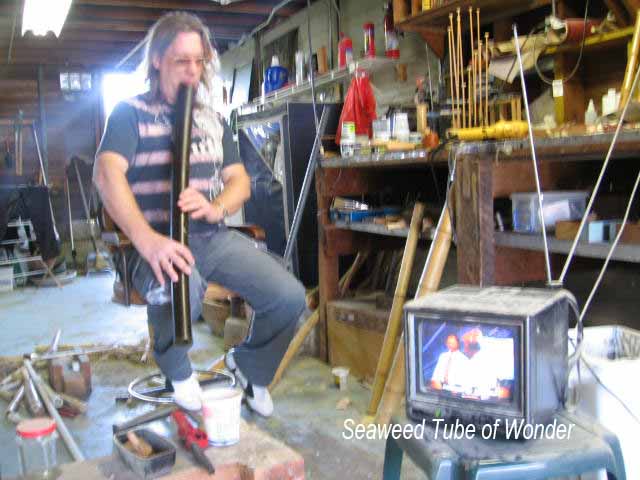
There is also a Taimu-like shakuhachi I call The Seaweed Tube of Wonder. Seaweed has a nicely tapered bore which is ideal for shakuhachi. They can be made in less than five minutes with a pocket knife and left on the beach when it’s time to go.
The response to Taimu seems to have been overwhelmingly positive. Have you experienced any resistance to Taimu in the shakuhachi community?
Taimu is an extreme style among many styles of shakuhachi. For those who are drawn to that particular sound and aesthetic, it seems to have been received well.
I don’t know about resistance, but I don’t expect it to be for everybody. The larger Taimu require a long finger span and big holes. This can be difficult or physically impossible for some with short and thin fingers. For those who are physically able to play them, we’ve found it is best approached as a different instrument than conventional size shakuhachi. When approached without preconception, the learning curve can be surprisingly easy.
Can you give a rough sense of how many Taimu have been made and what proportion get sent to different parts of the world? (USA, Japan, other places…)
My estimate would be almost one hundred Taimu made in the last ten years. Most of these are equally dispersed throughout the US, Europe and Australia. There are a smaller percentage in Canada, Japan, Asia and South America.
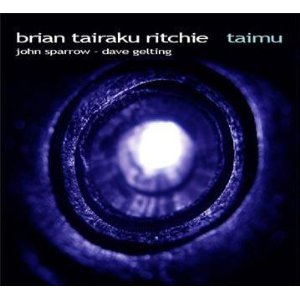
The Taimu project seems both to have responded to changing ideas about the shakuhachi, especially in the West, and helped shape those ideas. And Taimu have provided the basis for other creative projects: Brian Ritchie’s Taimu CD, Cornelius Boots’ Mukyoku and Kiku’s commission from Frank Denyer, to mention a few. Have these offshoot projects surprised you?
There has been a resurgence of the natural jinashi shakuhachi sound in the West. Taimu is certainly part of that resurgence in some way. I don’t know how much it is driving or responding to it though.
When I was making my first shakuhachi I never imagined it would lead to meeting and working with such creative people. Many years ago I remember selling shakuhachi at the Haight Street Fair in San Francisco. On the stage next to me the Violent Femmes were playing. Little did I know a decade later I’d be designing shakuhachi with the bands founder and playing Taimu with them in The Horns of Dilemma.

I co-produced the Taimu CD with longtime Femmes producer David Vartanian. It was a jaw dropping experience to work with such musical professionals. John Sparrow on cajon and Dave Gelting on bass provided superb accompaniment. I think Brian’s playing on that recording really put Taimu on the map.

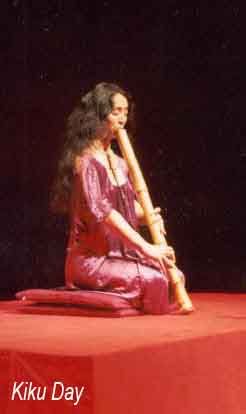
Kiku Day’s commission (Woman with Jinashi
Shakuhachi) from Frank Denyer was very encouraging. Denyer’s
music is distinguished by such a keen sensitivity to sound. So, it was
rewarding to hear of his attraction to the Taimu sound. Kiku is an
excellent example of approaching large shakuhachi without
preconception. Although her hands are not large she can easily play
very long shakuhachi because it was what she first learned on.
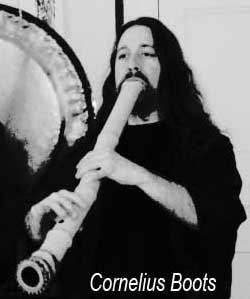
Cornelius Boots has helped increase interest in Taimu by creating a training and performance repertoire of twenty seven pieces specifically for Taimu shakuhachi. He’s performed a number of times with Taimu including a Black Sabbath tribute. He refers to Taimu as “The Barry White of the Shakuhachi World.”
In all my flutemaking projects, I felt if I could focus on the sounds I truly loved, and developed them with passion, there would have to be someone out there who shared that frequency. In that sense, it is very gratifying that composers and musicians of such caliber are tuning in. Shakuhachi making is largely a solitary endeavor. It is nice to peek outside occasionally to notice someone is listening.